

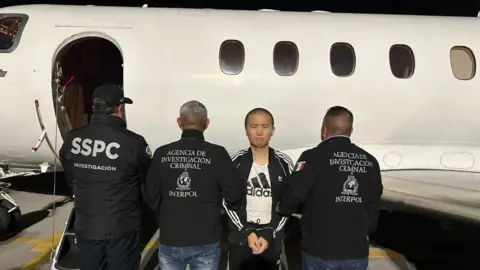
 Seretary Omar Harfuch Public Safety Department
Through a late-night announcement on Thursday, Cuban authorities stated that it had extradited an individual from China, Zhang Zhi Dong, to the authorities in Mexico. Shortly after, Mexico's security chief then confirmed his subsequent extradition to the United States on drug trafficking and money laundering charges.
It brought to an abrupt end a lengthy, audacious escape attempt by one of the world's most wanted fugitives.
Referred to by multiple names including Brother Wang, Pancho and HeHe, Zhi Dong Zhang faces charges from US prosecutors of masterminding an extensive global network involved in fentanyl distribution and illicit finance covering numerous nations with key operations in China, Mexico, and the United States.
The list of charges against Mr Zhang is long yet fundamentally US prosecutors and the Mexican Attorney General's office accuse him of being a major player within international narcotics trafficking. They say he has laundered millions of dollars in drug money for both the Sinaloa Cartel and the New Generation Jalisco Cartel (CJNG) as part of a worldwide drug distribution network.
"Brother Wang can be seen as an essential connection between Mexican cartels and Chinese chemical companies for obtaining fentanyl precursors", notes ex-DEA officer, a retired agent, who emphasized his crucial role in converting drug funds into cryptocurrency.
Upon being found guilty, Zhi Dong Zhang can expect to share a similar fate as other drug kingpins such as 'El Chapo' Guzman or 'El Mayo' Zambada within a maximum-security prison in the United States.
However, his detention in Havana represents a remarkable story involving fleeing house arrest in Mexico City, allegedly via a wall breach, boarding a private aircraft to Cuba and a finally unsuccessful effort to enter to Russia.
Zhi Dong Zhang was arrested in Mexico City through a coordinated law enforcement action during October 2024. He was first detained in a maximum-security prison but was later granted house arrest through a judicial order – a decision that President Claudia Sheinbaum called "outrageous".
Brother Wang's escape displayed all the characteristics of another embarrassing episode for Mexico: an individual deemed crucial in the machinery of drug smuggling, managing to vanish despite Mexican official surveillance tasked with guarding him. El Chapo accomplished this twice, to great US annoyance, prior to his ultimate extradition to the United States.
That Mexican authorities were able to recover their prisoner coupled with his northern transfer resulted from two factors – a fortunate development in Russia and robust Mexico-Cuba security ties.
When Zhang reached Cuba in July 2025, he began planning his subsequent moves towards reaching a country lacking a US extradition agreement, officials say.
A direct commercial air route exists to Moscow from Havana and Zhang, they allege, managed to book passage with fraudulent documents. Yet, these documents failed to clear the immigration authorities in Russia. It has been reported that the Russians didn't fully appreciate the identity of their detainee and, after he was briefly detained, they turned Zhang around and sent him back to Cuba.
On arriving back in Havana a second time, the Cuban security services were now aware of his real identity.
Security analysts believe Cuban officials retained him for several months for extensive questioning before sending him back to Mexico and, ultimately, transfer to the United States. Mexico's security secretary, Omar Harfuch, was quick to thank Cuba for their collaboration regarding 'Brother Wang' – ultimately, for sparing their blushes over another escaped high-profile prisoner.
Customarily after a suspected leader's capture, attention turns to what impact their apprehension will have on international narcotics trafficking.
Considering his recent year in incarceration, home confinement, or fugitive status, the question may be moot, Vigil commented, as his absence has already largely been felt in Mexico's criminal underworld:
"It's really not going to have an impact as the cartels already have individuals working for them capable of substituting Brother Wang", Vigil states. "Even with El Chapo Guzman a more prominent figure, it had no impact on the global drug trade", he argues.
Over his first year in office, US President Donald Trump has pressured his Mexican counterpart to do more on the issue of fentanyl trafficking and the Sheinbaum government has correspondingly acted. Her administration has boosted confiscations of the drug relative to the prior administration and her administration has sent dozens of convicted drug cartel members to the US to serve sentences there. They included several high-level drug names such as Rafael Caro Quintero, wanted for the murder of a DEA agent in 1985.
Collaboration on fentanyl matters, as well as on undocumented immigration, is considered the reason Mr Trump has refrained from imposing the same level of trade tariffs against Mexico as applied to other trade allies.
Zhang's transfer will bring genuine satisfaction to US officials at having taken a key figure from cartel financial activities from operation. This, subsequently, will satisfy the Sheinbaum administration in Mexico and reinforce their assertion to be in lockstep with their US counterparts on security.
Nonetheless, curbing or diminishing the flow of precursor substances from China to the Americas for fentanyl in any sustainable manner requires more than one individual's extradition.


